The Matrix Multiply Flip Graph
Two months of matrix multiply, of regret, loss, spring, sunburn, sore muscles, and a return to my bike. This post resumes the search for ways to multiply matrices with few multiplications. Some nihilistic hedonism propels me to continue this, but lately I reflect on how much I miss while absorbed by these things. I describe an interesting object called the matrix multiply flip graph, in which many world-record matrix multiply schemes have been found. We'll prove something new about its connectivity, then consider how to efficiently explore it using a GPU. The GPU-accelerated search procedure is quite fast, recovering the existing world-record scheme for matrix multiply in around thirty seconds on an RTX Pro 6000, compared to many GPU-weeks in the original publication. As of yet though, I have no new world-record schemes to report, hence this being a blog post.
Update: This did actually yield a world-record scheme for matrix multiplication and we wrote a paper about it here.
The vertices of the matrix multiply flip graph are ways to multiply matrices. Some ways require fewer multiplications than others; because multiplication is expensive in hardware, considerable effort has been spent exploring the flip graph to find them.
Concretely, the vertices of the matrix multiply flip graph are rank- decompositions of the matrix multiply tensor.
Definition 1. The matrix multiply tensor for multiplying two by matrices (note 1) is the unique satisfying, for any by matrices ,
That is, has shape and picks what products of elements of and sum to each element of .
is said to have a rank- decomposition if
for matrices with shape , where denotes the outer product. It is not too difficult to see that can be computed with multiplications iff has a rank- decomposition, as after substituting (2) into (1) one arrives at
As the terms do not depend on the values of , they can be precomputed. The terms are the only multiplications involving elements of and required for computing , so is said to computable with multiplies iff has a rank- decomposition.
It is natural then to say,
Definition 2. The vertices of the matrix multiply flip graph for multiplication of by matrices are all multisets
satisfying and having no elements that evaluate to zero.
It would be convenient if was connected to iff , but it is, as of yet, not known how to compute the out-neighborhood of a vertex in this graph. Instead, work thus far uses some subset of easily-computable flip, plus, and reduction edges. An interesting property of the edge-choice is if the resulting graph is connected, i.e. from any vertex every other vertex is reachable, as in a such a graph all unknown ways to multiply matricies are reachable from all known ones. In their work introducing the flip graph, Kauers and Moosbauer [1] showed with flip and reduction edges the resulting graph is weakly connected; after treating reduction edges as undirected, the graph is connected. Then, Arai, Yuma, and Hukushima [2] showed that full connectivity was achievable with a third edge, plus.
Despite connectivity proofs being for arbitrary fields, to our knowledge, all existing implementations search for schemes over , as over this field extremely fast search implementations are possible. Hence, this note investigates what edges are required for connectivity over . It is shown that over flip and plus suffice.
Definition 3. If can be transformed into via a flip or plus transform, then there is a flip/plus edge from to in the matrix multiply flip graph.
A flip on the position transforms into if there exists such that and
A plus on the position transforms into if, there exists ,
Flip and plus transforms are defined likewise to operate on the and positions of summands. If a flip transform results in a zero summand, that summand is dropped.
Theorem 4. Over , the matrix multiply flip graph with flip and plus edges is connected.
Connectivity Proof
Lemma 5. *The matrix multiply tensor for multiplying two by matrices is,
where is a by matrix with a at position and zeros everywhere else.*
Proof. As a consequence of (1), where denotes the Kronecker delta, so inspecting the basis-decomposition of we have,
Lemma 6. *If is a decomposition of , then
Proof. Write each and in the standard basis
By the definition of and the basis-form of , we have
Comparing the coefficient of the basis matrix on the left and right hand side of the equality, for any when we have , so every is a linear combination of 's. A symmetric argument applies to the and terms.
Lemma 7. *Let be a decomposition of over and , be elements of . There is a path from to
in the matrix multiply flip graph; likewise for and .*

Figure 1. Derivation of Lemma 7's when .
Proof. When , Figure 1 shows a derivation of .
If , a slightly different route is needed. After the first step we have
where . Applying to the last two summands, using as the pivot, gives
as desired. The and cases are symmetric.
Lemma 8. *Let be a decomposition of over . For arbitrary, nonzero , there is a path from to
in the matrix multiply flip graph.*
Proof. Fix a summand By Lemma 6, the -components of the summands of span , so there are terms satisfying
Thus, Lemma 7 gives a procedure to add two copies of
then
and so on, until two copies of are generated, at which point flips eliminate intermediate terms yielding . This is then repeated this on the and positions.
Lemma 9. Let be a decomposition of over . If sums to zero, i.e. , then there is a path from to in the matrix multiply flip graph.
Proof. Let denote the by basis matrix with a at position and zeros everywhere else. First, decompose every element of into basis matrices as follows: If the term of is not already a basis matrix, then , so add twice via Lemma 8
then do a flip on the position of the first and second terms above for
Repeating this for each element of 's decomposition and the and position decomposes into its basis matrices.
After decomposing the resulting scheme is , where is a multiset of basis-matrix outer products. Notice that the basis-matrix outer products are linearly independent, as is itself a basis tensor with a one at position and zeros everywhere else. Thus, for to be zero, every basis-matrix outer product in must appear an even number of times (i.e. its coefficient must be over ). Hence, as over a flip removes both inputs if they are the same, applying flips to identical elements removes , giving , as desired.
Proof of Theorem 4. To travel from any scheme to any scheme , first transition to by adding every element of to twice via Lemma 8. Then, as , , so is a subset of that sums to zero and can be removed per Lemma 9, leaving , as desired.
GPU-Accelerated Search
We now, somewhat unceremoniously, turn our focus towards how to efficently search the flip graph. As of yet, no better way to do this than random walks is known.
The most performance-sensitive part of random walks on the flip graph is identifying flip opportunities, i.e. summands that match in the , , or position.
Over an term fits in a single -bit word, so existing flip graph search procedures for small matrix sizes maintain, for each position , a map that stores the indices of summands with a particular value at that value. For example, if summands at indices have the value for their a term and is the map for terms, . For very small matrix sizes, or less, this map can be implemented with an array by interpreting term's bit-level representation as an index and larger sizes require hashing. However, this approach is not GPU friendly as it is branchy, requires operating on sizable buffers in shared memory, and, generally, is unclear how to adapt to the single-instruction-multiple-threads model used by GPUs (note 2).
Fortunately, recent CUDA GPUs have a primitive, __match_any_sync, that returns a bitmask of threads within a warp that have the same value for a given variable.
When there are fewer summands than threads in a warp this can be used as follows: Each thread stores a single summand. At each step all threads agree on a term position (, , or ) and execute __match_any_sync on their summand's value at that position. Ones in the resulting bitmasks correspond to flip opportunities. This means flips are identified with a hardware primitive instead of a hash table.
In practice, available GPUs have threads per warp. As world-record decompositions of and involve and summands respectively, multiple summands must be stored per thread. Flip search then becomes probabilistic: At each step warps agree on a term position then, for rounds, each thread picks a random summand and calls __match_any_sync. Increasing increases the likelihood that available flip opportunities are found.
Generalized Flips
With __match_any_sync it is zero-cost to identify multiple summands that share a term, as this corresponds to more than two bits being set in the returned bitmask. Flip semantics can be generalized to operate on multiple summands and used to look ahead for rank-reductions.
Lets sketch a flip opportunity as matrix multiplication over subterms with as multiply.
From this perspective, applying a flip has the same effect as transforming , above, into for a particular .
This is easily generalized to multiple summands with a shared term and arbitrary, invertible .
A consequence of this framing is, if the or terms are not lineally independent, then appropriate choice of results in a zero in the or vectors, and a zero corresponds to a rank-reduction. Thus appropriate choice of can skip ahead in the search space to find rank-reductions that may require many pairwise flip and plus transforms to set up the needed linear combination.
It remains to discuss how to efficiently determine if are linealy dependent on GPU. First, it seems to be the case that sets of summands sharing a term are overwhelmingly of size on the flip graph: in schemes sampled from random-walks there were sets of more than two summands sharing a term and had size ; Figure 2 visualizes this. Over determining if is lineally dependent reduces to determining if the sum (i.e. XOR, i.e. ) of any subset is zero. So, is a useful number, because as sets of size have non-empty subsets and warps have threads, we can assign each subset to a thread.
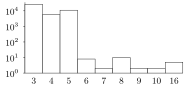
Figure 2. Distribution of sizes of sets of summands sharing a term from schemes sampled from random-waks on the flip graph.
More precisely, let be the index of a thread in a warp and be the indices of the set bits of . Thread zero is idle while threads compute
A warp ballot then finds the lowest-index thread for which the above is true. If one exists, call it thread and the index of its first set bit , threads rewrite their summands from
where
and the th summand is removed, i.e. set to zero.
To see the correctness of this,
Notes
- The exposition is on square matrix multiplication but is easily generalized.
- At a the necessary level of abstraction for this section, GPUs are composed of many processors composed of threads that all execute the same instruction at the same time. For example, two threads on a processor can simultaneously compute , but one cannot compute while the other computes , as and are different instructions. Branchy code performs poorly on GPUs because one thread cannot execute the false branch of an if statement while the other executes the true branch. Some primitives, like
__match_any_sync, allow threads in a warp to communicate with one another. If you'd like to understand GPU in more detail I made a considerable effort to explain in this post.
References
- Flip Graphs for Matrix Multiplication. Manuel Kauers, Jakob Moosbauer. arXiv preprint arXiv:2212.01175. 2022.
- Adaptive Flip Graph Algorithm for Matrix Multiplication. Yamato Arai, Yuma Ichikawa, Koji Hukushima. arXiv preprint arXiv:2312.16960. 2023.
Thanks to Ally, Anagha, and Quan.